Creating a trip
The itinerary, why it has to close, and the costs you record along the way.
Let the wizard ask
Beside New trip on the Travel screen there is Step by step. It asks one question at a time instead of showing you the whole editor at once: whose trip it is if you file for other people, what the trip was for, where you went, how the days went, what it cost, and finally what is still outstanding. A sketch of the report updates beside you as you answer, and on the last step you can look at the real document.
It writes an ordinary draft, so the two surfaces are the same trip: leave the wizard at any point after the second question and the draft is waiting for you in either one. A draft in the list has a Continue in the wizard action beside it.
Two things it settles early, because the server does:
- Who traveled is fixed when the draft is created. The per diem entitlement and the check that nobody holds two overlapping trips both belong to that person, so the wizard asks first and states the answer afterwards.
- Naming a client is optional and needs access to your client list. Without it the wizard asks only whether the trip was for your own business.
The itinerary is the backbone
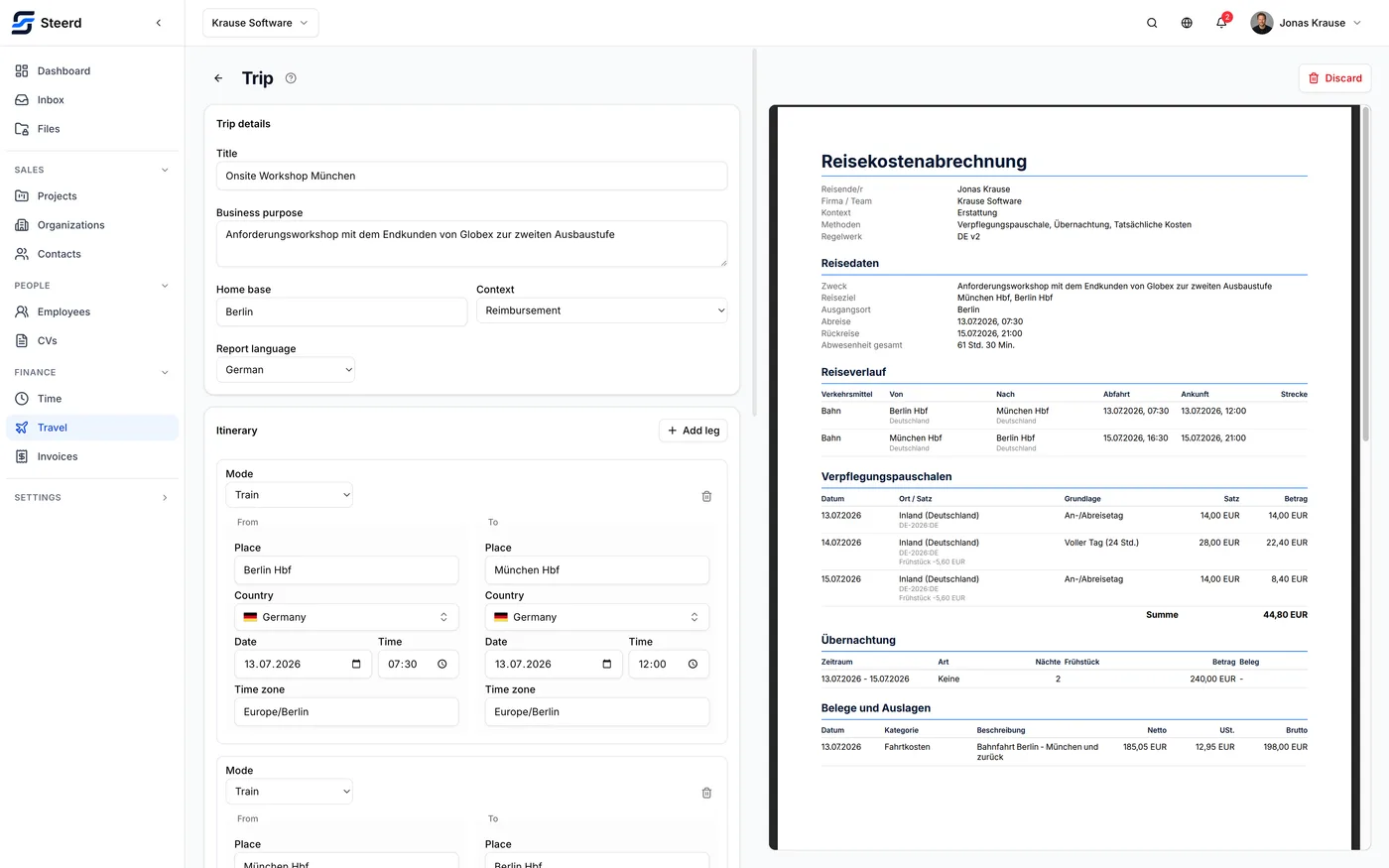
A trip is a sequence of legs: when you left, where you went, when you arrived, and how you traveled. Modes cover car, motorcycle, train, plane, public transit, taxi, rental car, ship and other.
The itinerary is not decoration. Everything statutory is computed from it: which days get a per diem, at what rate, and whether the three-month rule applies. Get the times right and the numbers follow.
Two rules the checklist enforces:
- The itinerary runs forward in time. No leg may start before the previous one ended.
- The itinerary returns to your home base. A trip that never comes home is an incomplete record, and an open-ended trip has no last day to compute against.
A business purpose
Required. "A business purpose is recorded" is on the checklist, because a trip without a stated business reason is not a business trip, whatever it cost.
Costs
Add what you spent, by category: accommodation, meals, transport, parking, tolls, luggage, communication, hospitality, other.
Each cost records who paid, which matters more than it looks. A hotel your employer booked directly is not money you are owed, and the checklist insists every cost says who paid it.
Foreign currency costs need an exchange rate. The checklist will not let a foreign-currency cost through without one, because a number in the wrong currency on a reimbursement is a number that is simply wrong.
Hospitality costs need a type. Entertaining clients is treated differently from feeding yourself, and the distinction has to be recorded rather than inferred.
Overrides
You can override a computed value, and every override needs a reason. That is the checklist item "Every override has a reason". An unexplained override is the thing an auditor asks about first, and the reason is much easier to write today than to reconstruct in two years.